I’m live tweeting Metra’s Board Meeting, which is virtual this month because of Covid-19 social distancing measures. It begins at 10:30AM. Here’s the link to watch … https://tinyurl.com/ux9bq4e
@CHIdocumenters
#ChiDocumenters #Metra
10:18 AM Apr 15, 2020 CDT

Responding to lower ridership numbers since the statewide shutdown, Metra cut weekday service on its commuter trains serving the downtown core. The reduced schedule has been in effect since March 23rd. Ridership began plummeted earlier in March by 50% https://tinyurl.com/vgh5avg
Metra is due receive $300 million in emergency federal funds a spart of the $2 trillion stimulus package passed by congress in late March. By end of March, Metra’s ridership was down 90%, causing a major anticipated budget shortfall. https://tinyurl.com/sf94m2e
Metra CEO James M. Derwinski has commenced the meeting. This is Metra’s first virtual meeting. Each board member will be reporting remotely, voting from “six towns away in some cases.” Roll call is happening. All 11 board members present.
Three public comments- mention of crosswalks at 87th in Gresham and another DesPlaines. Metra’s existing advertising partner Pulsar contests a procurement procedure and whether a new marketing contract with LKHS followed appropriate competitive bidding practices
Alberto Gonzalez of Los Angeles and CEO of Pulsar Advertising https://tinyurl.com/sft4r7galso questions the legitimacy of LKHS’s (http://www.lkhs.com/) M/WBE qualifications. Requests that Metra cancel the marketing contract and review the competitive bidding.
Motion by the chair to approve Consent Agenda for capital procurements from Feb 9 - March 17, 2020, including Highliner equipment and signalling infrastructure. Passes unanimously.
Motion by the chair to approve Consent Agenda for capital procurements from March 17 - April 14, 2020, including redesign of five stations, Oakenwald cemetery masonry repair and door part repair. Passes unanimously.
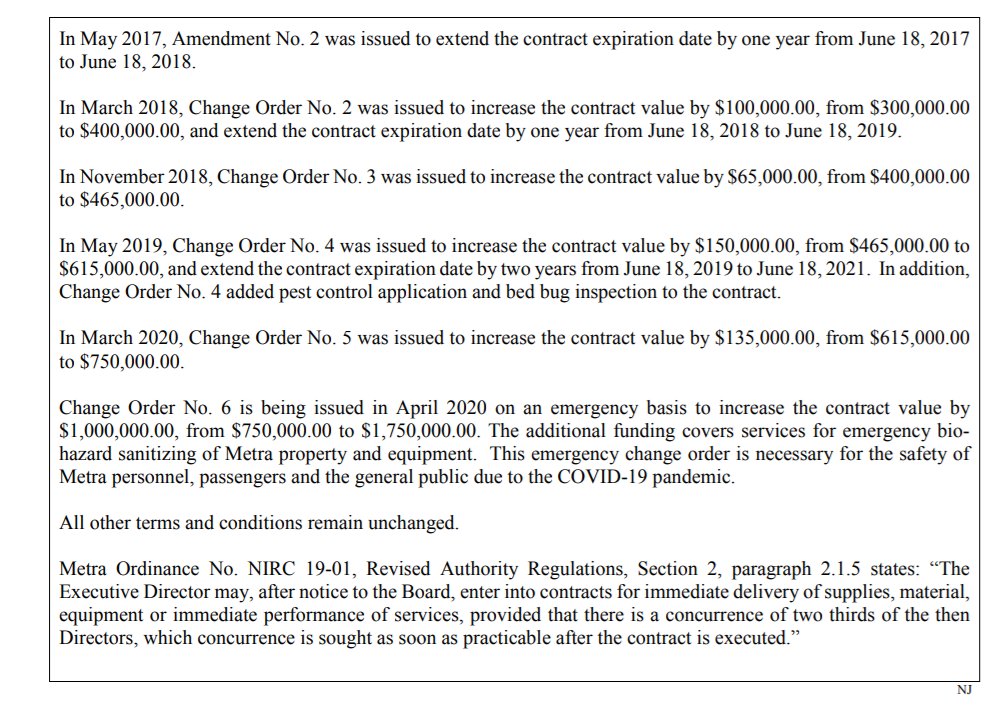
Board member questions Capital expense B1 from Feb 9-March 17. Sanitizing/Biohazard has been listed as a $1 million dollar cost. This seems high even in light of extra sterilization precautions because of the Corona virus.
Fix* B1 Biohazard is March 17 - April 14. Metra says “this is the only company that will come to scene” according to its police force. Usual cost is $20,000/period. “The $1 million won’t necessarily be spent in full.” “This is an emergency extension.”
Board member “I’m very worried about the spending” on Biohazard costs and training in the nature of the emergency. Metra official ensures “this is not a money grab … we initially thought we would need all this money ($1 million)” but now doubts the full amount will be needed.
Metra has already introduced a “Covid-19 tracking code” for tracking budget items and operating expenses for billing to FEMA (such as overtime, emergency service contracts etc.) “We have our ducks in a row.”
Another board member feels uncomfortable approving a max BioHazard contract for $1 million. Metra Police insists that this figure was based on extending what was the “burn rate” of sanitation costs when the virus first hit.
I’m wondering.... What will be Metra’s sanitation standard once normal services resume?? Unclear if this $1 million will cover the new cost of extra level deep cleaning.
B1 Change order for Biohazard Sanitation Contract passes. Directors Brown and Palmer vote against. B3 Passes unanimously. All other pass including nearly $500,000 expense for hand sanitizer and $1,500,000 cost for bottled water.
https://metrarail.com/sites/default/files/assets/about-metra/leadership/board_meetings/2020/202004/6_vi_b_operating_procurements.pdf Cleaning costs will jump from $100,000 to a possible $1.75 million https://t.co/zwm5pWngjB
Construction pipeline has halted for station improvement projects that weren’t shovel ready. Future federal fund will cover these costs down the road. Waukegan bathrooms underway, however, plans to extend platform on hold. Hubbard Woods TBD.
Engineering dept: platform extension will not happen because of a forecast change in operations. Shorter trains… does this mean less service or more frequent service? Will trains need to be longer in order to practice new social distancing reducing passenger capacity/car?
State of Operations Report (Feb/March) - On time performance avg held at ~95% all Feb and 96% all March (UP-North highest at ~98.5% both months). Roughly 1,400 fewer trains ran during the month of March because of COVID-19. Service cut by 50% after the Governor’s Shut-In order.
Metra logging half as many Freight train delays in March. This is the plus side of such low economic activity and industrial transportation during COVID-19.
Switch & Signal delays are usually the responsibility of rail operators. Issues in the past with Canadian National operations at junction 19 near O’hare. Trends in improvements or just less freight congestion out there? Answer: combo. PTC signalling system is helping.
“PTC” is positive train control, which is “a computerized system to prevent train-to-train collision.” COVID-19 shouldn’t interfere with Metra’s software implementation schedule.. https://metrarail.com/riding-metra/safety-environmental-compliance/positive-train-control-ptc
Metra discussing plummeting ridership. “It will be a rough several months as we ride some very empty trains.” “Commuter rail will not be the same after COVID-19.” Sanitation needs will have to be determined by the public.
Beginning April 2020, Metra was down to just 3% of its normal ridership! Anticipates that ridership will still be down to just 80% normal levels by December. In comparision, CTA is operating at 20% normal level this April. “We’ve been crushed..Ridership may never recover again.”
Telecommuting will become a big new trend, less commuting. Metra anticipates all kinds of resident relocations … “a massive shuffle” that will cause losing a lot of riders. People moving downtown, or out the ‘burbs further and telecommuting more.
Unemployment will be high for some period. It will inevitably hurt Metra’s ridership. Getting riders to return will be about “restoring confidence.” Gas prices will make auto commuting for attractive and also hurt ridership – “in some cases, we will never get them back.”
Board is now examining a 9 month revenue forecast for the rest of the year. This is very PROVISIONAL. Shortfall expected to be $192 Million, or down 53% in sales. RTA Sales tax revenue will be down $138.7 Million, or down 32%.
$525 Million shortfall anticipated for ‘20 and ‘21 together. Metra does not expect that the Federal stimulus will be enough to cover its budget without cuts.
Metra presenting strategy for launching a huge communications campaign … resolve to “Be Proactive, Be Marketers” Needed to get people back on the trains and restore their confidence in sanitation standards.
“A whole lot of new normal to figure out.” Stakeholders are needed, desperately, to weather through these tough times. “We need to actively innovate to meet the changing public needs.”
Member director of the Board… “The new horizon will come with opportunities.” He is enthusiastic about the possibility of implementing a pilot express train to O’hare in this landscape? This makes me curious … where’s the evidence that air travel is expected to bounce back?
The public needs to be informed that “It’s safer to ride the train than you may conceptualize… Let them know about proactive measures.” Lots of speculation by board members about how long stay at home orders will extend and what the horizon looks like for a vaccine.
CEO: Math is being done to determine adequate spacing according to CDC guidelines… how many train cars put into service will be needed to accommodate public health standards — ex. 10-30 passengers/car.
CEO: LKHS (Metra’s new social media marketing partner) “will be used aggressively.” http://www.lkhs.com/
CEO: Discussing the effects of COVID-19 and limits of public service governance … “Nobody can predict how society will change … We know because we couldn’t predict how commuters would behave when we did our study of the BNSF.” Funny.
Board member wants more info on the scenarios ahead for ridership, funding and service strategies and/or cuts. Maybe more or less express service. Longer or shorter trains. Possibility (“I hate to mention this”) of station closures.
“We are anticipating riders to return in May …We will be ready for that … The time is now.” Metra CEO responding to scenario preparedness post shut-in. Different lines might ramp up with service sooner than others depending on the riding public.
Metra CEO is highlighting the new marketing contract again ” We haven’t had this tool before.” They are really placing a lot of hope on this planned initiative coming into fruition in this landscape.... how far can advertising go to save Metra?
Metra’s first ever virtual board meeting in its history officially adjourned at 12:32pm CST April 15, 2020. Again, this meeting was conducted with board members participating and voting remotely from home due to the Covid-19 pandemic. See you next time from MetraHQ or the web!